
UX Design
We study how people use your product so we can make finding things simple.
Follow Us



A forward thinking design team using integrated AI technologies to create the perfect user experiences.
Get Started
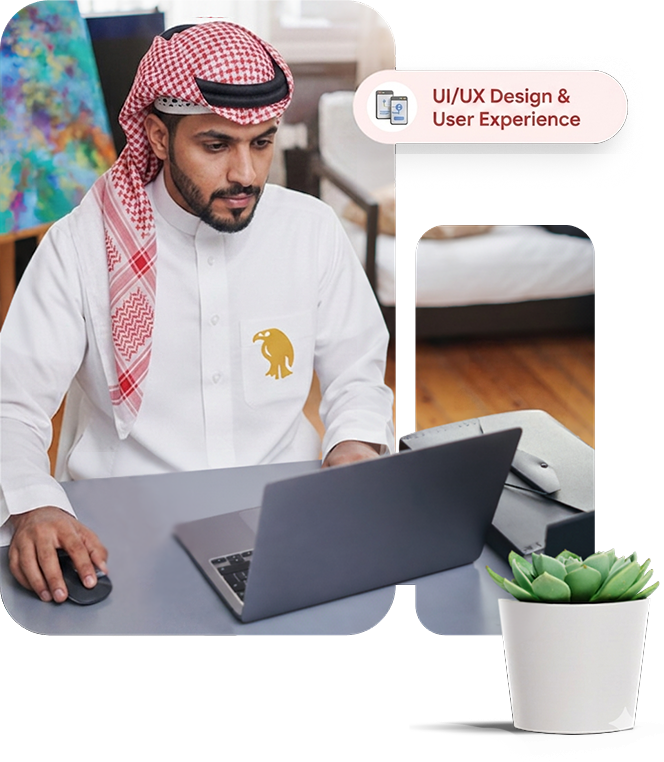
YAre you searching for a winning UI/UX design team to design your digital product to attract customers? If you want to invest in a website, mobile app or digital product design, Guru is the team to execute your project successfully. We can design the perfect user journey, and convince your customers to perform the required actions. Our UI/UX design agency in KSA can design mockups for web and mobile and share them with you so you can assess them in real-time. Our teams are aware of the modern digital trends & can exclusively work with AI tools and technologies to build winning user experiences.
When it comes to UI/UX design, we follow a structured & research-driven approach to ensure your digital product is intuitive, visually engaging and conversion optimized. We design to impress the customers following a data-driven approach where our data experts understand what the target audience expects of your product. We then create user journeys that appeal to your specific target market so they feel convinced and confident in your brand. A great UI/UX design is one that wins trust.
Guru provides you with the chance to earn and solidify your customers' confidence.
Get striking, intent-driven visuals engineered to convert casual traffic into your biggest revenue source.
Time is money—especially in the US market. AI engine generates ideas, while humans make them unforgettable. Our high-quality graphic design service provider takes a hybrid approach that combines machine-learning efficiency with award-winning designer intuition to create strong visuals to hook attention, feel authentic, and drive decisions.
At Guru, our objective is to design user experiences strategically to increase your website conversions and drive long-term growth for your business. We design digital products with the purpose of achieving success.
Contact Guru today to build your UI/UX design backed by an AI-driven approach.
Get Started
 Our Services
Here are the UI/UX design services which we offer to our customers.

We study how people use your product so we can make finding things simple.

We design clean, easy screens that match your style so visitors feel comfortable immediately.

We build clickable mockups of your app to test and fix mistakes before writing code.

We arrange your pages and layouts so your visitors know exactly what to do next.

We create a memorable logo, color scheme, and font choice that represents your business clearly.

We design how buttons and menus react to clicks to make your app feel smooth.
 Our Process
Our process starts with understanding your business, users, and project goals. We then transform those insights into seamless user experiences designed to improve engagement, usability, and conversions.

We interview your target customers to learn how they navigate and use your digital products.

We draw simple black and white layouts of each screen to plan the basic structure.

We add your colors, fonts, and images to turn the outline into final screen designs.

We build a clickable model of the design to test how real people use it.
Get distraction-free, intent-driven layouts engineered specifically to turn web traffic into revenue.
Great digital design isn’t just about aesthetic polish; it’s about reducing friction and driving user action. At our company, our UI/UX design philosophy blends human-centric empathy with data-backed intelligence. We leverage advanced AI tools to accelerate user research, map complex behavioral flows, and run predictive usability testing, freeing our design team to focus on pure, high-authority creative strategy. By anchoring every wireframe, intuitive interface, and seamless micro-interaction in real market dynamics, we build digital products that don't just look stunning, but inherently increase engagement, lower abandonment rates, and maximize your conversion metrics.
Get Started
Our Technologies
Adobe illustrator

Adobe XD

Adobe Photoshop

Adobe InDesign

Adobe After Effects

Figma

Sketch

Canva
Testimonials

(14+ reviews)
Helping world-class company by creative design.

They lead regular virtual meetings with us to update the project's content and keep us in the loop of the project's progress.
Sooraj Hosdurg
IT Administrator

The team was very helpful, adaptable, and easy to work with. The team communicated seamlessly and was always available throughout the project.
Mariam Jamal
PR Specialist, FAIC

They would want to go above and beyond to meet the expectations of their customers.
Tycoon Listings
Co-Founder & Project Manager

They communicated smoothly and was always available. Customers can expect a cost-effective and effective team.
Windsor University
Director of Operations & Marketing,

The team was very helpful, adaptable, and responsive and receptive to feedback.
Federal Authority for Identity & Citizenship
PR Specialist

I’ll never use a different website design company other than them—I’d recommend them to anyone.
Emacci LLC
CEO

Guru was very efficient in communicating, highlighting, and suggesting recommendations.
The Ceiling Fan Company LLC
Assistant Manager

Clientele








 FAQs
FAQsMost businesses assume low conversions are caused by weak marketing. In reality, many conversion losses occur after a visitor arrives. UI/UX design focuses on reducing friction at every step of the customer journey, from discovering a product to completing a purchase or submitting an inquiry.
A practical way to evaluate UX impact is through three indicators:
When these three factors improve, businesses often see higher conversion rates, lower abandonment, and stronger customer retention because users can achieve their goals faster and with less effort.
A complete UI/UX design service should solve business problems before creating visual designs. The process typically includes user research, competitor analysis, information architecture, wireframing, user flow mapping, interface design, prototyping, usability testing, and developer handoff.
For businesses operating in Saudi Arabia, additional considerations often include Arabic-first experiences, right-to-left (RTL) interface design, mobile-first interactions, cultural preferences, and localized customer journeys. These factors influence how users navigate, read content, complete forms, and interact.
A successful UI/UX design service in KSA combines global usability standards with local user behavior.
User research is the process of identifying what users are trying to accomplish, where they struggle, and what influences their decisions.
Rather than relying on assumptions, UX teams collect evidence from multiple sources:
The objective is not to learn what users say they want.
The objective is to understand what users actually do when completing a task.
This distinction often reveals hidden friction points that affect engagement and conversion.
Project timelines depend on complexity, user requirements, and the number of screens involved.
A useful way to estimate a UI/UX project is by dividing it into four stages:
| Stage | Typical Duration |
|---|---|
| Discovery & Research | 1-2 Weeks |
| Wireframing & User Flows | 1-3 Weeks |
| Visual UI Design | 2-4 Weeks |
| Testing & Refinement | 1-2 Weeks |
Most business websites are completed within four to eight weeks, while SaaS platforms, enterprise dashboards, and mobile applications may require longer timelines due to additional research, testing, and workflow complexity.
Yes. While the design principles remain consistent, each product category requires a different approach.
The design process adapts to the environment, user expectations, and business goals of each product rather than applying the same interface patterns across every project.
Designing for Saudi audiences requires more than translating content into Arabic.
Effective localization considers reading patterns, device preferences, navigation behavior, cultural expectations, and trust signals that influence decision-making.
Key considerations often include:
The goal is to create experiences that feel native to local users rather than adapted from another market.
A professional UI/UX project should provide documentation that supports both design decisions and development implementation.
Common deliverables include:
These deliverables help maintain consistency throughout the project while reducing misunderstandings during development.
A redesign should be driven by evidence rather than aesthetics.
Businesses typically benefit from a UX redesign when they observe one or more of the following:
A useful rule is this:
If users can find your business but struggle to complete important actions, the issue is often not traffic generation. It is a user experience.
A redesign becomes valuable when improving usability can produce greater returns than acquiring additional traffic.